 Over 6,000 visits a month
 Over 2,500 doctors
 Over 800 blood tests and services
 Unique offers at MediClub
- Medicover
- Diagnostic tests
- Prenatal testing
- VERAgene - non-invasive prenatal testing (NIPT)
VERAgene - non-invasive prenatal testing (NIPT)
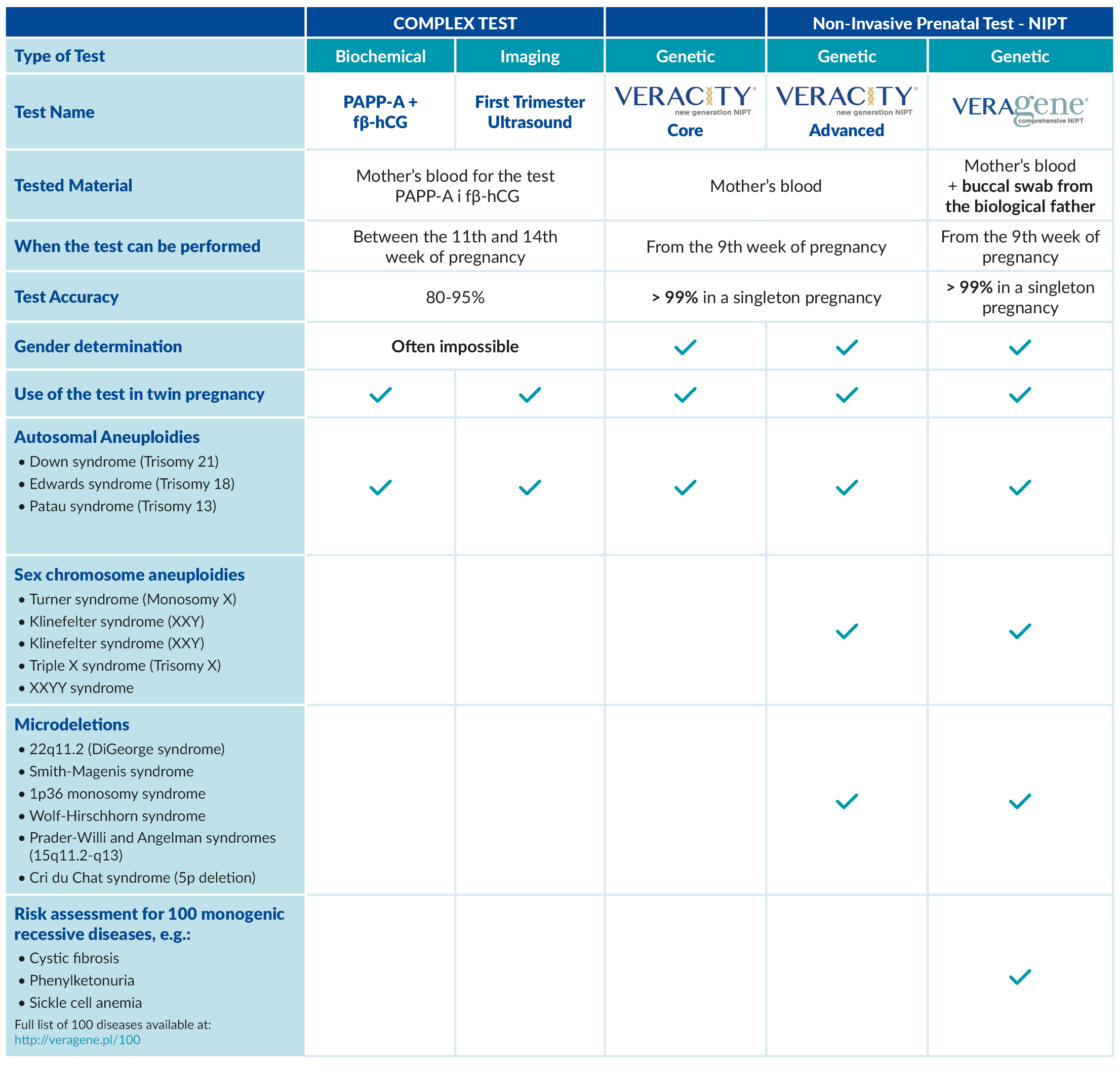
VERAgene is a non-invasive prenatal test (NIPT) for aneuploidy, microdeletions and point mutations. It detects 2,000 mutations through the screening for 100 monogenic diseases.
Buy cheaper - join MediClub and pay 490 PLN less.
The price includes all fees
Lowest price from 30 days before discounting PLN 2,555.50What is VERAgene NIPT?
The VERAgene test is used to assess the risk of genetic disorders – aneuploidies, microdeletions and point mutations. The test detects 2,000 gene mutations responsible for metabolic diseases such as cystic fibrosis, phenylketonuria and blood disorders (e.g. sickle cell anaemia).
VERAgene is safe and does not involve invasive procedures, so there is no additional risk to the pregnant woman or the foetus.
Which genetic diseases can be detected through the VERAgene test?
The test makes it possible to detect a very broad spectrum of disorders, especially microdeletions, aneuploidies and monogenic diseases. The most common disorders include:
Aneuploidies:
- Down syndrome (trisomy 21);
- Edwards syndrome (trisomy 18);
- Patau syndrome (trisomy 13);
- Turner syndrome (monosomy X);
- Klinefelter syndrome (XXY);
- Jacobs syndrome.
Aneuploidy is a type of mutation that involves an abnormal number of chromosomes in the foetal cells. In the case of trisomy, the foetal cells receive an extra (third) chromosome, while monosomy results in only one chromosome from the pair being present in the cells.
Microdeletions:
- DiGeorge syndrome;
- Smith-Magenis syndrome;
- Wolf-Hirschhorn syndrome;
- 1p36 deletion syndrome.
A microdeletion is understood as the absence of a very small piece of a chromosome. Many microdeletions have little impact on the health and life of a child, but there are some that can cause mental disability and birth defects. Microdeletions occur during pregnancies with the same frequency regardless of the mother's age, which means that a woman's young age does not affect the incidence of this chromosomal abnormality. The risk is similar for babies born to women in their twenties and those over forty years of age.
Monogenic diseases, such as:
- cystic fibrosis;
- chorea-acanthocytosis;
- phenylketonuria;
- sickle cell anaemia;
- autism spectrum disorder-epilepsy-arthrogryposis syndrome.
For a complete list of diseases and defects that can be diagnosed by the test, please click here: VERAGENE
For whom is the test intended?
The test is intended for women:
- of all ages;
- from the 10th week of pregnancy;
- having singleton and twin pregnancies as well as suffering from the vanishing twin syndrome;
- after in vitro fertilisation (excluding IVF with a donor egg).
The child’s biological father should also take part in the test.
Contraindications for the test include:
- a higher-order multiple pregnancy;
- the risk of a specific genetic defect shown by the PAPP-A test being greater than 1:100 (in such a case, it is necessary to undergo an invasive test, e.g. amniocentesis);
- identified mosaicism of the placenta, mother or foetus;
- organ or bone marrow transplantation in the mother;
- the mother undergoing a blood transfusion within the past 1-2 months;
- diagnosis of a balanced translocation in the mother;
- the mother suffering from malignant tumour (currently or in the past).
What are the advantages of undergoing the VERAgene test?
If you decide to undergo the VERAgene test at Medicover, our specialists will provide you with comprehensive medical care. As part of the service, we guarantee a free consultation with a clinical geneticist and a psychologist for any patient who receives a high-risk result.
There are many benefits to undergoing the VERAgene test. When making the decision to do so, expectant parents should know that:
- The test is non-invasive and completely safe. It does not affect the course of the pregnancy.
- VERAgene has the broadest diagnostic spectrum on the market. It is also the only test to identify the risk of monogenic diseases.
- The test is highly accurate, with over 99% accuracy for trisomies 21, 18, and 13 as well as sex chromosome aneuploidies and microdeletions. In addition, VERAgene’s positive predictive value when it comes to detecting monogenic diseases exceeds 99%.
- It is the only test on the market that includes the analysis of a genetic material taken from the father.
Preparation for the test
The VERAgene test is performed based on blood samples collected from the mother and a buccal swab taken from the biological father.
Genetic tests are dependent primarily on the quality and quantity of DNA in the collected material. For one hour prior to the collection of material for the VERAgene test, the biological father should refrain from:
- eating or drinking anything (except for water);
- chewing gum;
- brushing his teeth;
- smoking cigarettes.
Please remember to bring your ID card or any other identity document to the appointment.
You can undergo VERAgene within 3 months of its purchase (counting from the date indicated in the order confirmation).
To make an appointment for the test, please call our hotline on +48 500 900 505. The appointment will take place at the blood drawing point. A referral can be completed on site with the assistance of the medical staff. A referral from a doctor is not required.
Result
The test result will be available in about 7-10 working days.
In most cases, the test result is negative, which means that the baby will most likely be born healthy. Such a result puts parents at ease and allows them to navigate the pregnancy without worrying about the baby's health. A positive result, indicating a high risk of at least one detected anomaly, makes it possible to plan the next steps and ensure that the appropriate care is provided to both the parents and the baby – from the very first moments of life.
If the patient undergoes the test at a Medicover Medical Centre or at Medicover Hospital, the result will be sent to the patient by email to the address indicated in the referral. In the case of a result showing a high risk of a disease entity, the patient will be contacted by a gynaecologist.
Others also bought

Scope of the test: trisomies (13, 18, 21), X and Y chromosome aneuploidies (singleton pregnancy), microdeletions, Y chromosome (sex identification).